
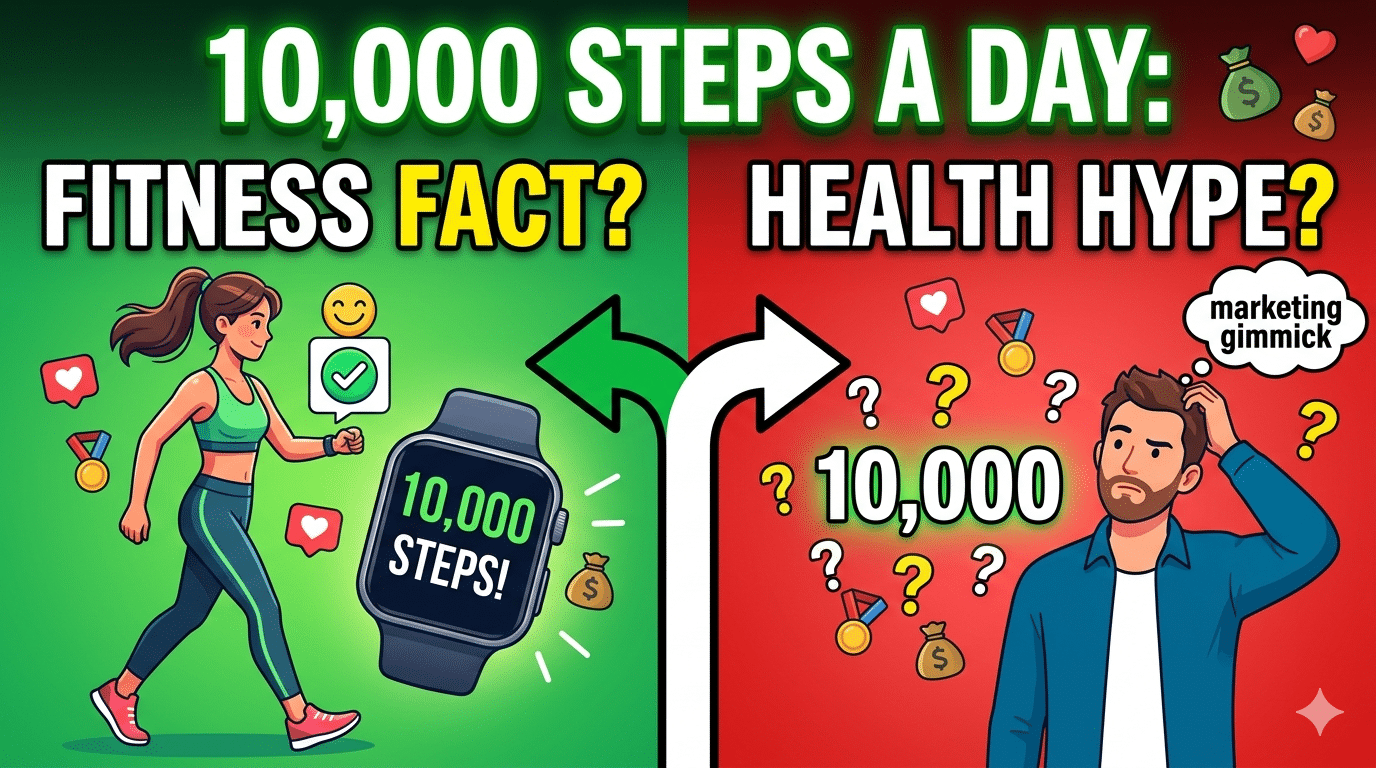
10,000 Steps a Day: Fitness Fact or Health Hype?
If you own a smartphone, a smartwatch, or a fitness tracker, you are likely haunted by a single number: 10,000. It has become the universal gold standard for physical activity. We check our wrists at 9:00 PM, see 8,400 steps, and feel a sudden pang of guilt that drives us to pace around the living room like a caged animal until the "achievement" notification pops up.
But for the man over 40, whose time is a precious commodity squeezed between corporate demands and family obligations, we have to ask: Is 10,000 steps a scientifically proven necessity, or just a clever marketing gimmick? At DadBod40, we cut through the noise. In this 1,200-word deep dive, we explore the surprising origins of the step-count craze, what the actual medical research says for middle-aged men, and how you can use walking as a secret weapon to reclaim your prime without becoming a slave to your pedometer.
The Marketing Myth: Where 10,000 Came From
You might assume the 10,000-step goal was the result of a multi-year clinical trial conducted by Harvard or the World Health Organization. It wasn’t. The number actually dates back to 1965, when a Japanese company called Yamasa Clock produced a pedometer called the Manpo-kei. In Japanese, "Man" means 10,000, "po" means steps, and "kei" means meter. Translated: The 10,000-step meter.
Why 10,000? Because the Japanese character for 10,000 looks vaguely like a person walking. It was catchy. It was a round, impressive-sounding number. It was, quite literally, a marketing slogan. There was no medical data at the time to suggest that 9,999 steps were insufficient or that 10,001 was the threshold for immortality. Yet, for over half a century, this arbitrary figure has dictated the fitness goals of millions.
What the Science Says in 2026
While the origin was marketing, the science has spent the last several decades playing catch-up. Researchers have wanted to know if this arbitrary goal actually translates to longer lives and better health. For men over 40, the findings are encouraging—but they suggest that the "sweet spot" might be different than you think.
The "Diminishing Returns" Threshold
Recent longitudinal studies published in JAMA Internal Medicine suggest that significant mortality benefits begin to plateau after roughly 7,500 to 8,000 steps.
For men in their 40s and 50s, reaching 7,000 steps a day is associated with a 50-70% lower risk of premature death compared to those taking fewer than 5,000 steps. Interestingly, increasing the count from 8,000 to 12,000 steps showed only marginal additional gains in longevity. This is great news for the busy dad: you don't necessarily need to hit the "magic 10k" to reap the lion's share of the health rewards.
Why Walking is the "Secret Weapon" for Men Over 40
At DadBod40, we prioritize strength training, but walking is the perfect "LISS" (Low-Intensity Steady State) partner to heavy lifting. Here is why those steps matter more as you age:
1. Metabolic Health and Blood Sugar Control
As we age, our insulin sensitivity often takes a hit. Walking—especially a 10-minute stroll after a meal—acts as a "glucose sponge." Your muscles use the sugar in your bloodstream for fuel, preventing the insulin spikes that lead to fat storage around the midsection. For the man trying to lose the "dad bod," those steps are essentially free fat-burning insurance.
2. Joint Longevity
High-impact cardio like running can be brutal on 40-year-old knees and lower backs. Walking provides a cardiovascular stimulus without the eccentric load that causes joint inflammation. It increases blood flow to the cartilage in your hips and knees, keeping them lubricated and "young."
3. The "Cortisol Killer"
Middle age is often the most stressful period of a man’s life. Between the mortgage, career pressure, and parenting, our cortisol levels are chronically elevated. High cortisol is a muscle-killer and a fat-magnet. Walking, particularly outdoors, has been proven to lower sympathetic nervous system activity (the "fight or flight" response) and clear the mental fog.
Fact vs. Hype: The Verdict
The Hype: There is nothing magical about the number 10,000. It is not a "fail" if you hit 8,500. Furthermore, 10,000 steps cannot replace the need for resistance training. You can walk 15,000 steps a day and still suffer from sarcopenia (muscle loss) if you aren't lifting weights.
How to Hit Your Goal Without Trying
For the busy man, "going for a walk" isn't always feasible. You have to bake the steps into your existing life. Here is the DadBod40 strategy for hitting 8,000+ steps without checking your watch every five minutes:
- The "Phone Call Pacing" Rule: Never take a work call sitting down. If you're on a 30-minute Zoom (where your camera can be off) or a standard mobile call, pace your office or walk around the block. That’s an easy 2,500 steps.
- The Far-End Parking Hack: It’s a cliché because it works. Stop hunting for the closest spot at the grocery store or the office. Park at the back. It adds 500 steps to every trip.
- The 10-Minute Post-Dinner Stroll: Instead of collapsing on the couch after dinner, grab the dog or your spouse and walk for 10 minutes. It aids digestion and chips away at that step goal.
- The "Walk and Talk" Meeting: If you're meeting a colleague for coffee, get it to go and walk while you talk. You'll find the conversation is often more creative and productive.
Integrating Steps with Your 2026 Workout Plan
Don't view walking as your "workout." View it as your baseline activity level. Your week should still revolve around 3–4 days of deliberate strength training. Use your daily steps to keep your metabolism humming and to recover from your heavy lifting sessions. Walking increases blood flow to sore muscles, flushing out waste products and speeding up repair.
In the hierarchy of health for men over 40, the pyramid looks like this:
- Sleep: 7–8 hours (The Foundation).
- Nutrition: High protein, whole foods.
- Strength: Lifting heavy 3x per week.
- Steps: 7,000–10,000 daily (The Metabolic Engine).
The Bottom Line: Just Keep Moving
Is 10,000 steps health hype? Only if you think it's a magic requirement for fitness. Is it a fitness fact? Yes, in the sense that human beings are evolved to move, and most of us don't move nearly enough. For the man over 40, don't obsess over hitting a perfect 10,000 every single day. Aim for a weekly average of 8,000.
If you hit 10,000, great. If you hit 7,500 but you also crushed a 45-minute leg workout, you’ve won the day. Stop letting the marketing of the 1960s dictate your happiness. Focus on the trend of your activity, not the perfection of the count.
Ready to combine those steps with a real strength program? Join our community and get our "Prime After 40" starter guide, designed to help you build muscle, burn fat, and actually enjoy the process.

J.V. CHARLES – DadBod40
J.V. Charles is a certified coach and the founder of DadBod40. He specializes in helping busy men over 40 optimize their physiology through simple, sustainable habits. He believes that fitness should fit into your life, not the other way around. He currently averages 9,200 steps a day—but he doesn't lose sleep over the other 800.