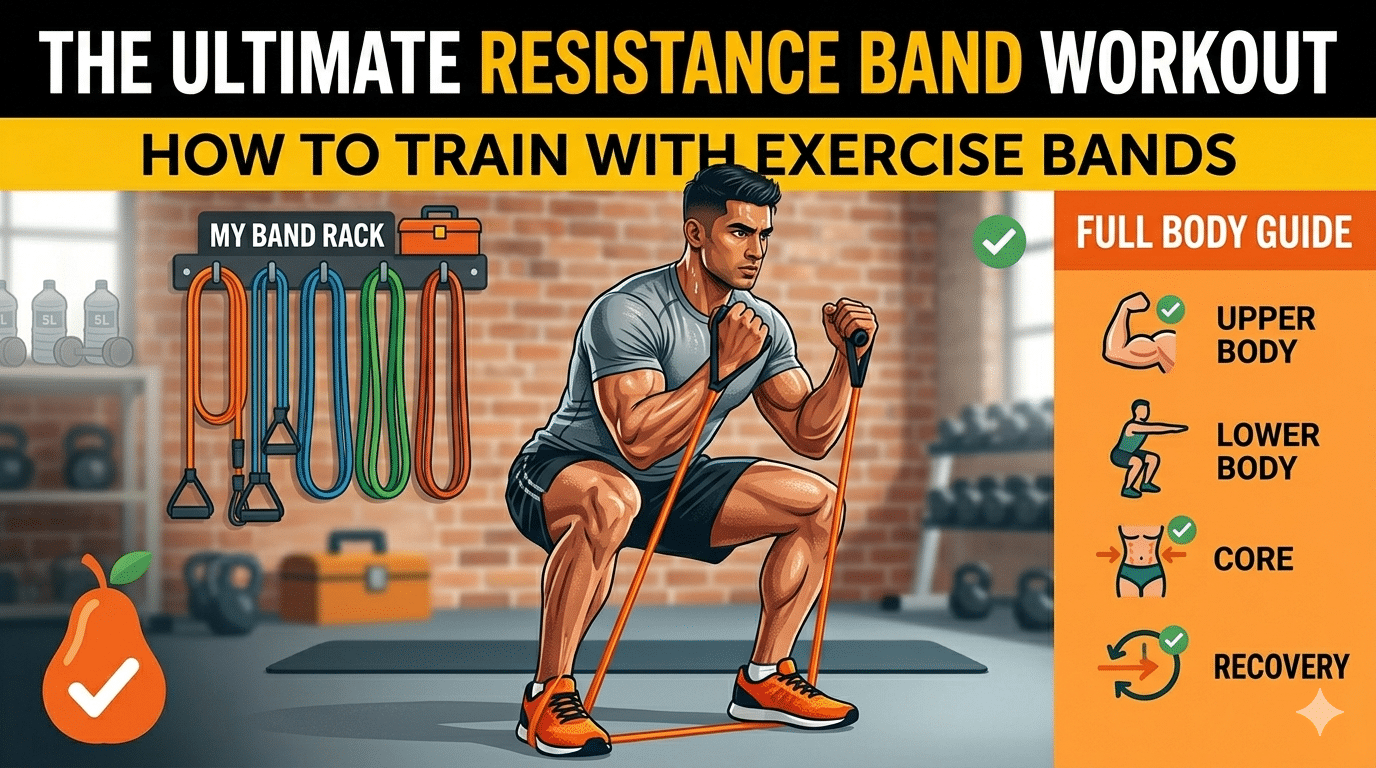
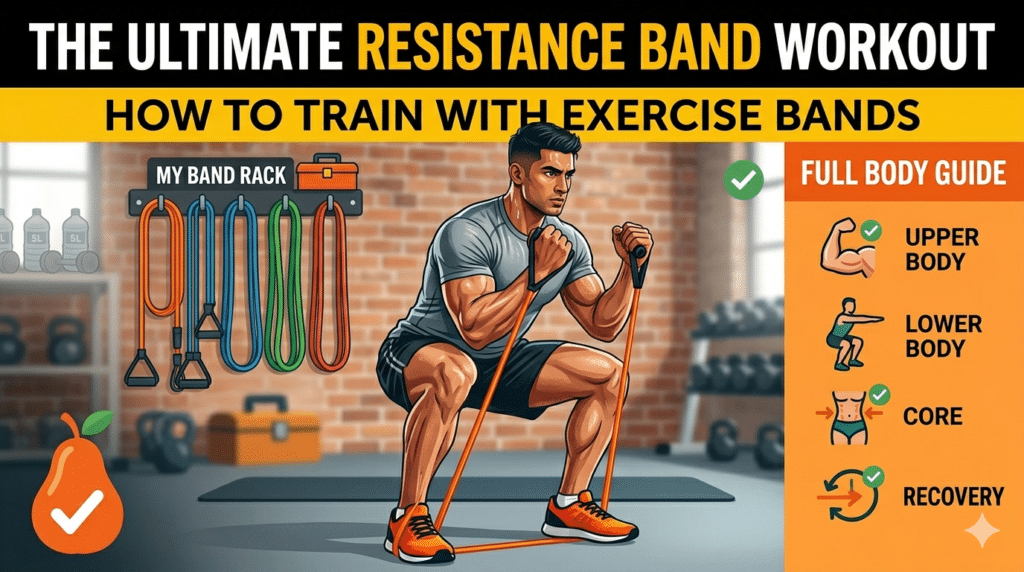
The Ultimate Resistance Band Workout: How to Train With Exercise Bands
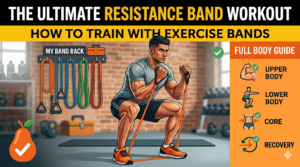
Resistance bands are one of the smartest, most underrated tools for men over 40. They’re cheap (a full set costs $20–$50), take up almost no space, travel anywhere, and deliver joint-friendly tension that builds real strength, burns fat, improves mobility, and protects against injury — all without heavy weights or a gym membership.
Unlike free weights that rely on gravity, bands provide variable resistance: the further you stretch them, the harder they pull. This matches the body’s natural strength curve, making exercises feel smoother on joints while still challenging muscles throughout the full range of motion. Studies show resistance band training produces similar (and sometimes superior) gains in strength, muscle size, and power compared to traditional weights — especially when progressive overload is applied.
Whether you’re training at home, in a hotel room, or outdoors, this guide gives you the 10 best band exercises, a complete full-body workout program, progression strategies, and tips to maximize results after 40. No fluff — just effective training you can start today with minimal equipment.
Why Resistance Bands Are Perfect for Men Over 40
No momentum or impact — bands load muscles smoothly and reduce stress on elbows, shoulders, and knees compared to heavy barbells.
Variable resistanceHardest at the strongest part of the movement (full stretch) — perfect for building power and protecting joints at weak points.
Portable & affordableA set of 5–6 bands (light to extra-heavy) fits in a backpack and costs less than one gym session — lifelong investment.
Full-body versatilityPush, pull, squat, hinge, core — one set does it all. Great for travel, small spaces, or when recovering from injury.
Progressive overload made easyCombine bands, shorten length, or slow tempo to increase difficulty — no need for heavier weights.
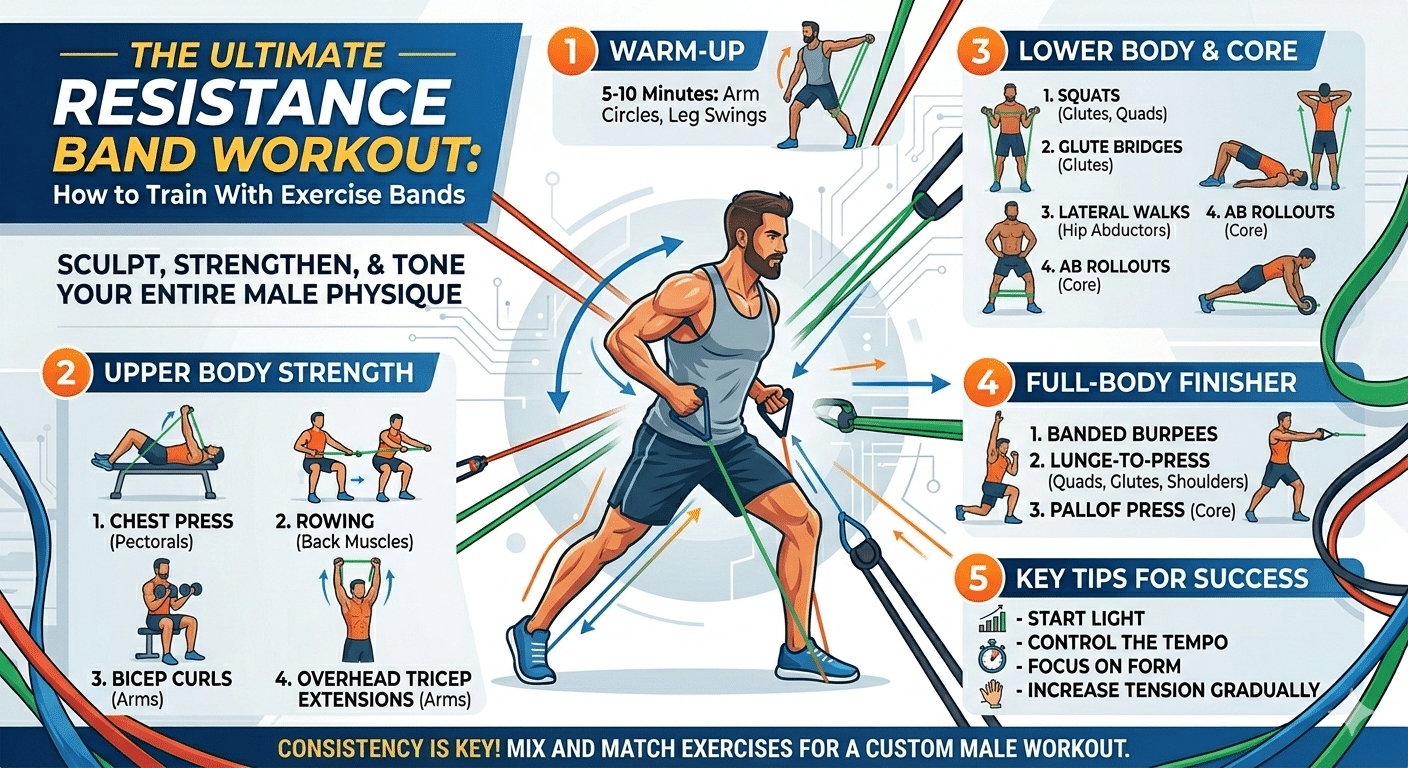
The 10 Best Resistance Band Exercises for Men Over 40
Hold band at chest height, arms straight. Pull hands apart, squeeze shoulder blades. Great for posture and shoulder health.
3–4 sets of 15–25 reps
Anchor band at face height. Pull toward face, elbows high, squeeze rear shoulders. Best shoulder injury prevention move.
3–4 sets of 12–20 reps
Anchor band behind you. Press forward like bench press. Can do standing, kneeling, or floor press variation.
3–4 sets of 10–15 reps
Anchor band low. Pull handles to ribs, squeeze shoulder blades. Single-arm or double-arm versions.
3–4 sets of 10–15 reps per arm or both
Stand on band, hold handles at shoulders. Squat deep, then press overhead as you stand. Full-body compound move.
3–4 sets of 10–15 reps
Stand on band, hold handles. Hinge at hips, keep back flat, stand tall. Builds glutes, hamstrings, and low back safely.
3–4 sets of 10–15 reps
Band around knees or ankles. Step sideways, keep tension. Activates glute medius — key for knee/hip stability after 40.
3 sets of 10–15 steps each direction
Anchor band at chest height. Hold handle with both hands, press straight out, resist rotation. Best core stability move.
3 sets of 10–12 reps per side
Stand on band, press handles overhead. Safer on shoulders than barbell due to natural path.
3–4 sets of 10–15 reps
Stand on band for curls, anchor high for extensions. Finishers that build arm size and definition safely.
3 sets of 12–20 reps each
Full-Body Resistance Band Workout Program (3–4× Per Week)
Warm up 3–5 min: arm circles, leg swings, light band pull-aparts.
- Band Pull-Aparts — 3 sets of 20–30 reps
- Banded Chest Press — 3–4 sets of 12–15 reps
- Banded Rows — 3–4 sets of 12–15 reps per arm
- Banded Squat + Press — 3–4 sets of 10–15 reps
- Banded Romanian Deadlifts — 3–4 sets of 12–15 reps
- Pallof Press — 3 sets of 10–12 reps per side
- Lateral Band Walks — 3 sets of 12–15 steps each direction
Rest 60–90 seconds between sets. Total time: 35–45 minutes. Use medium-to-heavy bands — you should reach near failure in the rep range.
How to Progress & Get Stronger With Bands
Bands allow endless progression without buying new equipment:
- Double up bands for more resistance
- Shorten band length (stand on more of it)
- Slow eccentrics (4–5 sec lowering phase)
- Add pauses at peak tension
- Increase reps or sets over time
- Move to single-limb variations
- Track band color/tension level and aim to beat previous workouts
Every 4–6 weeks change 1–2 exercises or grips (e.g., neutral to supinated) to keep stimulus fresh.
One Set of Bands. Lifelong Gains.
Resistance bands aren’t a “backup plan” — they’re a primary training tool that delivers serious strength, muscle, fat loss, and joint health benefits for men over 40. Portable, affordable, and incredibly versatile, they fit any lifestyle: home, travel, office, outdoors.
Buy a quality set (light to extra-heavy, with handles and door anchor). Start with the full-body workout 3 times per week. Progress consistently. In 8–12 weeks you’ll notice better posture, stronger lifts, visible muscle definition, and energy that carries through your day.
Want weekly resistance band programs, progression charts, and DadBod40 workouts built for men over 40? Join the free newsletter here — real training that fits real life, anywhere.
About the Author

J.V. CHARLES – DadBod40
Helping men over 40 build strength, burn fat, and stay mobile — with smart tools like resistance bands that work anywhere, anytime. Simple. Effective. Sustainable.