
Resistance Training for Seniors: The Insurance Policy for Your Golden Years
At DadBod40, we talk a lot about "reclaiming your edge" in mid-life. But as we look further down the road toward 60, 70, and 80, the mission changes. It’s no longer just about looking good in a tailored shirt; it’s about maintaining the biological autonomy to live on your own terms. It's about ensuring that your body doesn't become a prison.
We’ve been sold a lie that aging is a slow, unavoidable slide into frailty. The truth is that much of what we call "aging" is actually disuse. Resistance training is the most powerful biological intervention we have to stop that slide. It is quite literally the insurance policy for your future self.
The Enemy: Sarcopenia and Dynapenia
After age 30, most adults lose 3% to 8% of their muscle mass per decade. This rate accelerates significantly after age 60. This condition is called Sarcopenia. But there is a second, even more dangerous condition: Dynapenia—the loss of muscle strength.
Loss of strength happens at a rate three times faster than the loss of muscle mass. When you lose strength, you lose the ability to catch yourself if you trip, the power to get out of a low chair, and the stability to carry groceries. Resistance training doesn't just "tone" muscle; it renovates the nervous system to keep your power output high.
1. Reversing Bone Density Loss (Wolff’s Law)
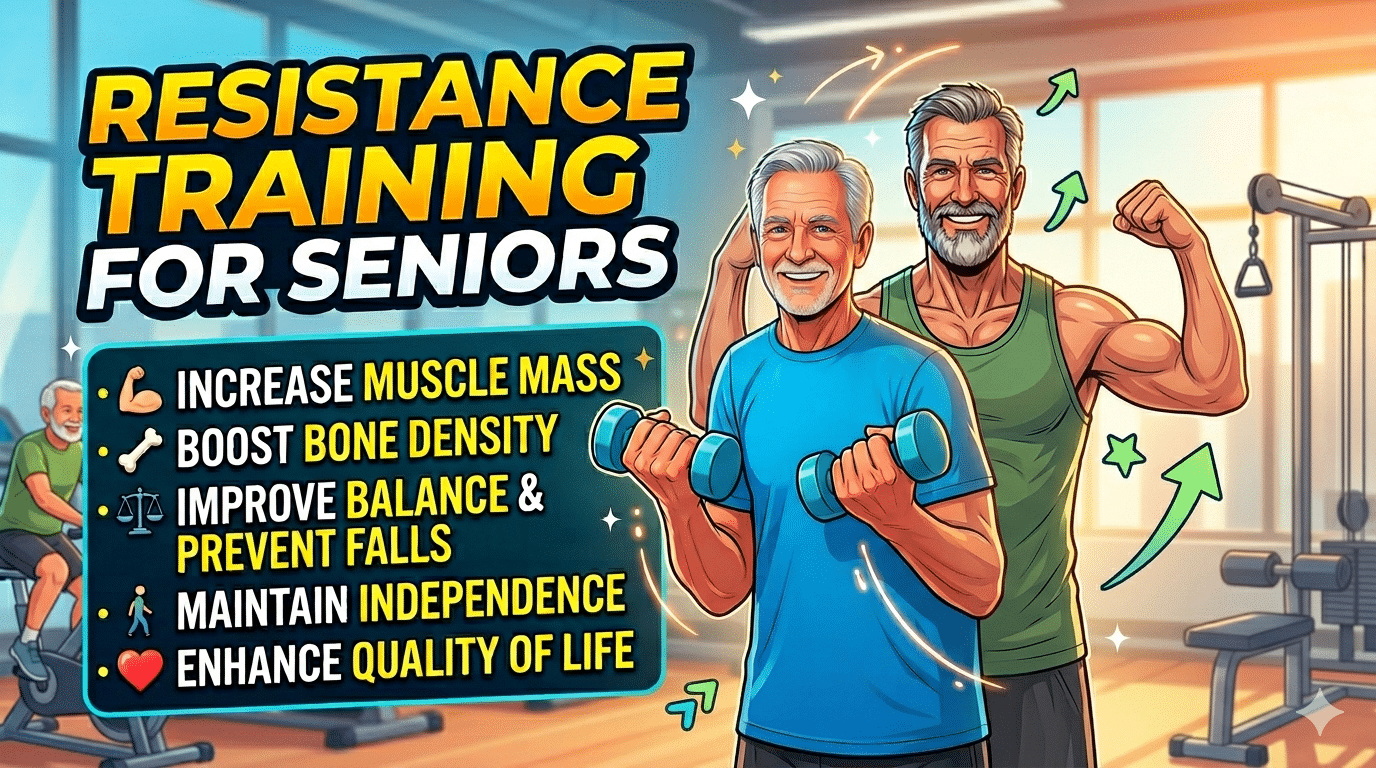
Resistance training is the king of bone health. According to Wolff’s Law, bone in a healthy person or animal will adapt to the loads under which it is placed. When you lift weights, the mechanical tension pulls on the bone, signaling your body to deposit more minerals (calcium) and increase density.
For seniors, this is the ultimate defense against osteoporosis and life-altering fractures. A 20-year-old’s broken arm is a nuisance; an 80-year-old’s broken hip is a catastrophic event. By lifting weights, you are building a skeletal "fortress" that can withstand the inevitable bumps of life.
2. Metabolic Mastery: Muscle as an Endocrine Organ
Muscle isn't just for movement; it is your body's primary metabolic sink. It is where you store and burn glucose. As we age, our bodies often become less efficient at managing insulin, leading to Type 2 diabetes and systemic inflammation.
Resistance training increases the number of GLUT4 transporters in your muscle cells, which act like "gates" that pull sugar out of your blood and into the muscle where it belongs. This improves insulin sensitivity and metabolic rate, making it significantly easier to maintain a healthy weight and avoid the "Metabolic Syndrome" that plagues the modern senior.
The DadBod40 Senior Resistance Matrix
Not all training is equal. To get the maximum longevity ROI, your routine should prioritize these three pillars.
| Training Pillar | Senior Focus | Longevity Payoff |
|---|---|---|
| Compound Movements | Squats, Hinges, Presses | Functional Independence & Balance |
| Isometric Holds | Planks, Wall Sits | Joint Stability & Pain Management |
| Power Training | Fast Concentric Movements | Fall Prevention (Reaction Time) |
| Grip Strength | Farmer's Carries, Hangs | Strongest Predictor of All-Cause Mortality |
3. Cognitive Health: IGF-1 and the Brain
We often forget that the brain is part of the body. When you perform resistance training, your muscles release Myokines—signaling molecules that travel to the brain. One specific factor, **Insulin-like Growth Factor 1 (IGF-1)**, has been shown to support neuroplasticity and memory.
Studies have consistently demonstrated that seniors who engage in twice-weekly strength training show marked improvements in executive function, attention, and memory compared to those who only do aerobic exercise. Lifting weights is, quite literally, a brain workout.
4. The Hormonal Lift (Wildcard: Isometrics)
While we often focus on the "big lifts," for seniors with joint issues (arthritis, bursitis), Isometric training is the secret weapon. Isometrics involve holding a muscle in a contracted state without moving the joint (like a wall sit). This builds massive strength and triggers a hormonal response—including a boost in natural Growth Hormone—without the wear and tear of high-repetition dynamic movements.
If you are starting after age 60, follow these rules:
1. **Focus on the Eccentric:** Lower the weight slowly (3 seconds). This is where most muscle growth happens.
2. **Grip Strength is Life:** If you can't hold it, you can't lift it. Farmer's carries are the most functional "longevity" exercise in the gym.
3. **Two Days is the Magic Number:** Research shows that 2 days of resistance training per week provides 80% of the benefits of 4 days for seniors. Consistency beats intensity.
5. Emotional Resilience and Agency
The psychological impact of being strong cannot be overstated. As people age, they often feel a loss of control over their environment. When you can still deadlift your own body weight at 70, or carry your own luggage at 80, you maintain a sense of agency. You are a participant in life, not a spectator. This mental toughness is the cornerstone of a high-quality late-life experience.
Getting Started Safely
The biggest hurdle for seniors is the fear of injury. The irony is that the lack of training is what makes you fragile and prone to injury. Start small. Use resistance bands or machines to master the movement patterns before moving to free weights. Work with a coach who understands "Corrective Exercise" and "Senior Fitness." Your goal is to be better next year than you were last year.
The Bottom Line: You Aren't Done Yet
At DadBod40, we believe that your 60s and 70s should be your most capable years. Strength isn't just for the young; it is a necessity for the old. Resistance training is the only thing that can physically turn back the clock on your muscle quality and bone density.
Stop thinking about "maintenance" and start thinking about "performance." You have the capacity to grow stronger at any age.
Ready to build a body that lasts? Join the DadBod40 Newsletter for more no-BS guides on strength, longevity, and reclaiming your edge.

J.V. CHARLES – DadBod40
J.V. Charles is a performance coach and longevity researcher focused on helping men navigate the transitions of mid-life and beyond. He believes that muscle is the most valuable currency you can own as you age.