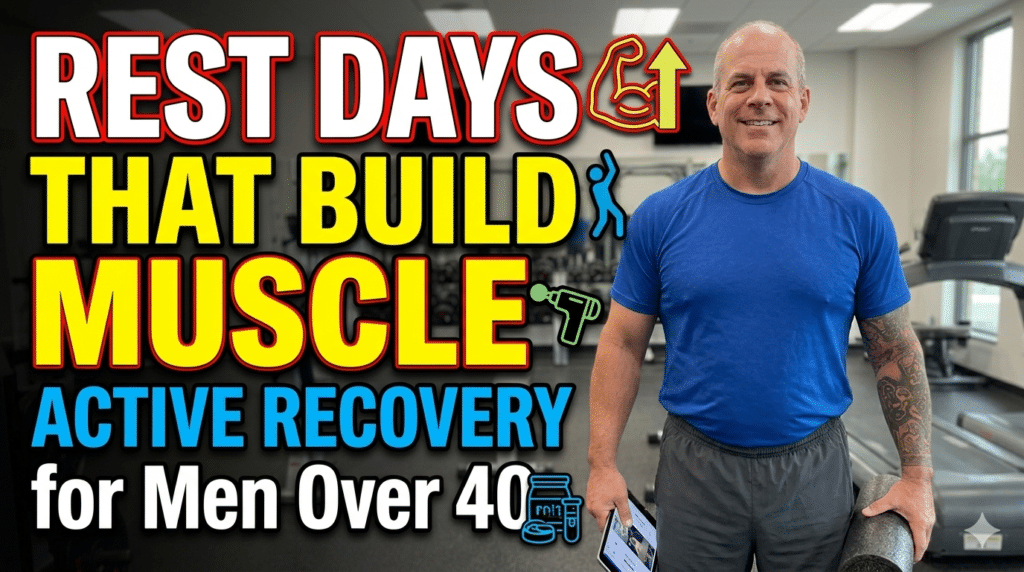
Active Recovery for Men Over 40: Rest Days That Actually Build Muscle
You hit the gym hard yesterday. You pushed through your one-hour workout, hit your target reps, and walked out the door feeling like a conqueror. Today is your scheduled rest day. Naturally, your instinct as a man over 40 is to sink deeply into the most comfortable chair in your house, grab the remote control, and barely move a muscle for the next 24 hours. After all, rest means resting, right?
Wrong. In your 20s, you could afford to be completely sedentary on your days off. Your highly elastic tissues and roaring metabolism would handle the repair process while you played video games. But in your 40s, passive recovery—doing absolutely nothing—often leads to stiffness, pooled metabolic waste, and that dreaded "tin-man" feeling the next morning. If you want to build muscle efficiently and protect your aging joints, you need to upgrade your rest days. You need to master the art of active recovery.
The Difference Between Resting and Recovering
Let's clarify the terminology. "Resting" is the absence of training. "Recovering" is a proactive, targeted effort to return your body to a state of readiness. Muscle does not grow while you are under the barbell; the lifting simply provides the stimulus. Muscle grows in the 48 hours *after* the workout, when your body rushes amino acids and nutrients to the micro-tears in your muscle fibers.
How do those nutrients get delivered? Through your bloodstream. And how do you increase blood flow without tearing down more muscle tissue? By moving gently. Active recovery operates on a very simple physiological principle: low-intensity, non-taxing movement acts like a pump. It flushes out cellular debris (like lactic acid and other metabolic byproducts) and shuttles fresh, oxygen-rich blood into the damaged tissues. For a man over 40, whose circulation and tendon elasticity are naturally declining, this "pumping" effect is the holy grail of physical longevity.
Why Sitting is the Enemy of Soreness
When you sit completely still after a brutal leg day, your muscles enter a protective, shortened state. The fascia—the connective tissue surrounding your muscles—begins to stiffen. If you spend eight hours at a desk the day after doing heavy goblet squats, you are practically begging for lower back pain and knee stiffness. You aren't "resting" your joints; you are immobilizing them.
To keep the machine running smoothly, you have to apply the old sports medicine adage: Motion is lotion. Synovial fluid, the natural lubricant in your joints, is produced and circulated through movement. By executing an active recovery routine, you lubricate your knees, hips, and shoulders, ensuring that when you go back to the gym for your next strength training session, your joints are supple and ready to bear weight.

The "Do Not Do" List for Rest Days
Before we discuss what you should do, we need to address a trap that highly motivated men frequently fall into: turning a rest day into a stealth workout.
The "Just a Light Sweat" Trap
Your nervous system doesn't care if you call it a "light day." If you go for a grueling 5-mile run, do 100 burpees in your garage, or participate in a high-intensity interval training (HIIT) class on your day off, you are not recovering. You are actively digging a deeper recovery hole. At 40+, your central nervous system (CNS) needs a break just as much as your muscles do. Active recovery must remain strictly low-intensity.
The golden rule of active recovery is the Talk Test. If you are doing an active recovery session and you cannot easily hold a casual conversation without catching your breath, you are going too hard. Keep your heart rate under 120-130 beats per minute. You are aiming for a gentle, rhythmic hum of the cardiovascular system, not a roar.
The Best Active Recovery Modalities for Men Over 40
You don't need fancy equipment to execute a perfect active recovery day. Here are the three most effective, dad-bod-approved methods to bounce back faster.
1. Purposeful Walking
Never underestimate the power of simply putting one foot in front of the other. A brisk 30 to 45-minute walk is arguably the greatest active recovery tool on earth. Walking stimulates the muscles in your lower body rhythmically without exposing them to eccentric loads (the part of a movement that causes muscle damage). It also helps de-stress the mind, lowering cortisol levels, which in turn promotes better hormone balance and testosterone production. Consider following a structured walking plan specifically on your days off from the weights.
2. Mobility Work and Iso-Holds
As we age, we lose our end-range of motion unless we actively train it. Spend 15 minutes moving through bodyweight mobility drills. Focus on the areas that get locked up from modern living: your thoracic spine (upper back), your hips, and your ankles. Simple movements like cat-cows, bodyweight lunges with a long stretch, and deep, unweighted squat holds signal to your nervous system that it is safe to relax tight muscles.
3. Low-Resistance Cycling or Rowing
If you prefer to stay in the gym, hop on a stationary bike or a rowing machine. Set the resistance to an incredibly low level—so low that it almost feels too easy. Keep a steady, effortless pace for 20 minutes. This creates a massive flush of blood through the quads, hamstrings, and lats, clearing out soreness without putting any impact stress on your aging joints.
The 20-Minute Over-40 Recovery Blueprint
Try this simple, foolproof routine on your next rest day to maximize muscle growth and joint health:
- Minutes 0-10: Brisk outdoor walk or low-resistance stationary bike. (Get the blood flowing).
- Minutes 10-14: Deep bodyweight squats. Move slowly. Pause at the bottom for 3 seconds on each rep. Focus on opening the hips.
- Minutes 14-17: Thoracic spine rotations. (Get on all fours, place one hand behind your head, and rotate your elbow up toward the ceiling).
- Minutes 17-20: Dead hangs. Grab a pull-up bar and simply hang for 30-45 seconds at a time. This decompresses the spine and stretches tight lats and shoulders.
The Longevity Payoff
It takes mental toughness to lift heavy weights, but it takes profound discipline to know when to pull back. By replacing total inactivity with active recovery, you are making a conscious investment in your physical longevity.
You aren't just trying to look good for a beach vacation next month; you are trying to build a body that functions flawlessly when you are 50, 60, and beyond. Stop viewing your rest days as a break from your fitness journey. They are an active, crucial phase of the process. Get up, get moving, flush the system, and watch how much stronger you feel the next time you pick up the iron.

Joshua Van
Joshua Van is the founder and senior editor of DadBod40. He’s helped thousands of men navigate the often-intimidating world of fitness after 40. Joshua believes that fitness is not a display of ego, but a foundational requirement for living a high-performance life as a father, professional, and man.