
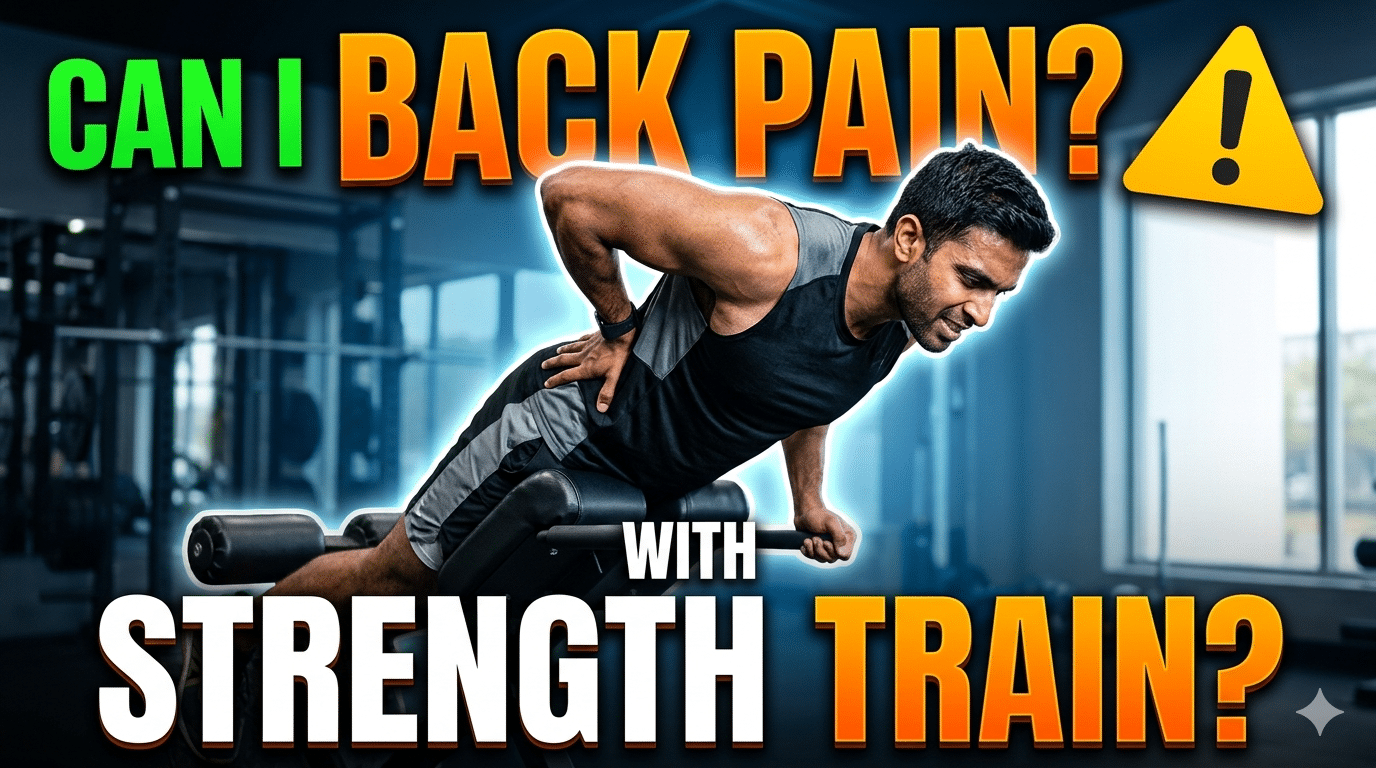
Can I Strength Train With Back Pain?
It usually happens on a Tuesday. You’re halfway through a set of deadlifts, or maybe you just leaned over to pick up a stray sock, and—snap. The lower back tightens, the panic sets in, and your first thought is: "Well, there goes my progress for the next six months."
At DadBod40, we don't buy into the "complete rest" myth. For men over 40, stopping entirely is often the fastest way to ensure that "tweaked" back becomes a chronic disability. The question isn't if you can train, but how. This is your guide to navigating back pain without surrendering your edge.
The "Hurt vs. Harm" Distinction
The first thing to understand is that pain does not always equal tissue damage. Our backs are incredibly resilient structures, but they are also highly "reactive." When the nervous system perceives a threat—even if the actual injury is minor—it will lock down the surrounding muscles in a protective spasm. This hurts like hell, but it doesn't mean your spine is broken.
Strength training, when done correctly, is actually the cure for most back pain. It increases blood flow, reinforces the "bracing" mechanisms of the core, and desensitizes the nervous system. The goal is to find the "Entry Point"—the level of movement that challenges you without pushing you into a "flare-up."
The Red Flags: When to Stop and See a Pro
Before we discuss modifications, we need to address the "Red Flags." If you experience any of the following, close this browser and call a doctor immediately. These signal potential nerve compression or serious structural issues:
- Sharp, shooting pain that travels down the leg (Sciatica).
- Numbness or "pins and needles" in the groin or feet.
- Sudden weakness in one leg (e.g., your foot "slaps" the ground).
- Loss of bowel or bladder control (Cauda Equina Syndrome).
If your pain is localized to the muscles of the lower back and feels more like an intense "ache" or "stiffness," you are likely cleared to modify and move.
| The "Problem" Lift | Why It Hurts | The "Back-Friendly" Alternative |
|---|---|---|
| Barbell Back Squat | High spinal compression & shear | Goblet Squats or Landmine Squats |
| Conventional Deadlift | Long lever arm; easy to round back | Trap Bar Deadlift (High Handles) |
| Overhead Press | Easy to hyperextend the lumbar | Seated Dumbbell Press or Z-Press |
| Sit-ups / Crunches | Repetitive spinal flexion under load | McGill Big 3 (Bird-Dog, Side Plank, Curl-up) |
Strategy 1: Modification vs. Elimination
Most "DadBod" lifters make the mistake of deleting an entire movement pattern. "I can't squat anymore," they say. This is a mistake. Instead of deleting the pattern, modify the leverage.
The Goblet Squat Hack
The Back Squat places the load on top of your spine, which can "squish" the vertebrae. By switching to a **Goblet Squat** (holding a kettlebell or dumbbell at your chest), you shift the center of mass forward. This naturally forces your core to engage and keeps your torso more upright, taking the pressure off the lower back while still torching your quads.
The Trap Bar Salvation
If deadlifts are your nemesis, the Trap Bar (or Hex Bar) is your best friend. Because you stand inside the bar rather than behind it, the weight is aligned with your center of gravity. This reduces the "shearing" force on your lumbar discs. Use the high handles to limit the range of motion until your back feels stable.
Strategy 2: The Core is a Shield, Not a Spring
In your 20s, you might have done hundreds of sit-ups to get abs. In your 40s, that’s a recipe for a herniated disc. The function of the core isn't to move the spine; it’s to prevent the spine from moving under load. This is called "Anti-Extension" and "Anti-Rotation."
Focus on "Isometric" core work. Movements like **Dead Bugs**, **Bird-Dogs**, and **Pallof Presses** teach your nervous system how to lock the spine in a neutral position while your arms and legs move. This creates a "stiffness" that protects your back during heavier lifts.
Dr. Stuart McGill, the world's leading spine biomechanist, recommends three specific exercises to build "spinal hygiene." If you have back pain, these should be your daily non-negotiables:
1. **The Modified Curl-up:** Builds anterior core without spinal flexion.
2. **The Side Plank:** Targets the quadratus lumborum (a major back stabilizer).
3. **The Bird-Dog:** Builds posterior chain endurance and cross-body stability.
Strategy 3: Breathing and Intra-Abdominal Pressure
If you aren't using the Valsalva Maneuver, you're leaving your spine vulnerable. This involves taking a big "belly breath" and bracing your abs as if someone is about to punch you in the gut—then holding that pressure throughout the rep.
This creates a cushion of air and pressure (Intra-abdominal pressure) that supports the spine from the inside out. Think of your torso like a soda can: if it's full and pressurized, you can stand on it. If it's empty or leaking air, it collapses instantly.
The "Movement is Medicine" Protocol
When the pain is acute (the first 48-72 hours), your only job is to walk. Walking is the best low-level "rehab" exercise for the back. It creates a gentle, rhythmic loading and unloading of the discs and keeps the muscles from freezing up. Aim for three 10-minute walks a day.
Once you return to the gym, follow the **"Pain Rule"**:
- 0-3 Pain: Safe to proceed.
- 4-6 Pain: Modify the range of motion or reduce the weight.
- 7+ Pain: Stop the movement and find an alternative.

J.V. CHARLES – DadBod40
J.V. Charles is a longevity researcher and performance coach. Having navigated his own share of "back tweaks" over a 20-year lifting career, he specializes in helping men train through and around injury to stay in the game for the long haul.