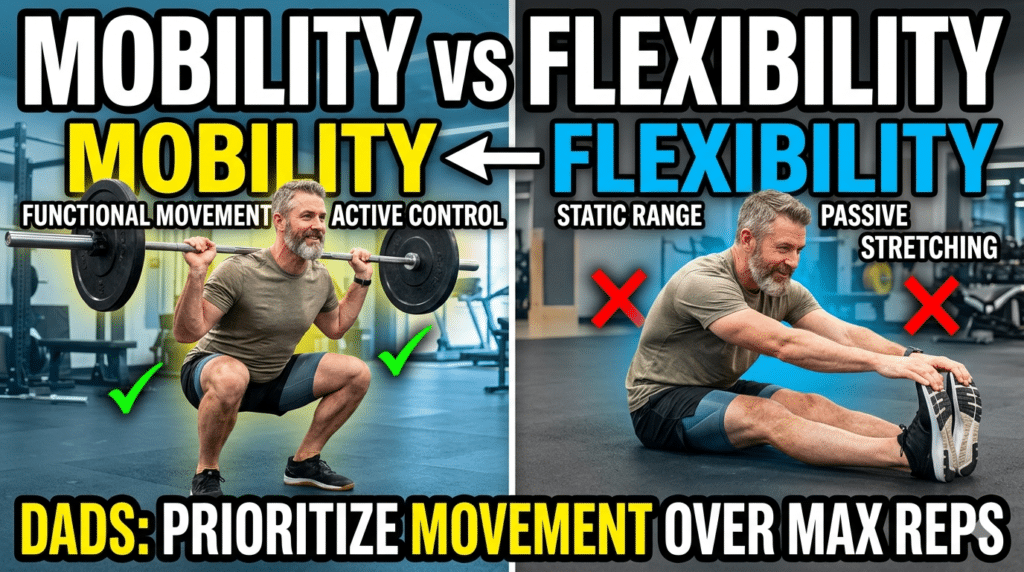
Mobility vs. Flexibility: Why Dads Need to Prioritize Movement Over Max Reps
For decades, the standard of fitness for men was simple: How much do you bench? We were taught that progress was measured in plates on the bar and "max reps" on the bench. But for the man over 40, those metrics are beginning to fail us. In mid-life, the real indicator of fitness isn't just raw strength—it’s the ability to put on your socks without sitting down, to pick up your kids without a "twinge" in your lower back, and to move through life without a soundtrack of clicking joints. At DadBod40, we believe it’s time to stop chasing numbers and start chasing movement.
The Great Confusion: Mobility vs. Flexibility
In the fitness world, these two terms are often used interchangeably, but they represent two vastly different physiological states. Understanding the difference is the key to unlocking a body that feels as good as it looks.
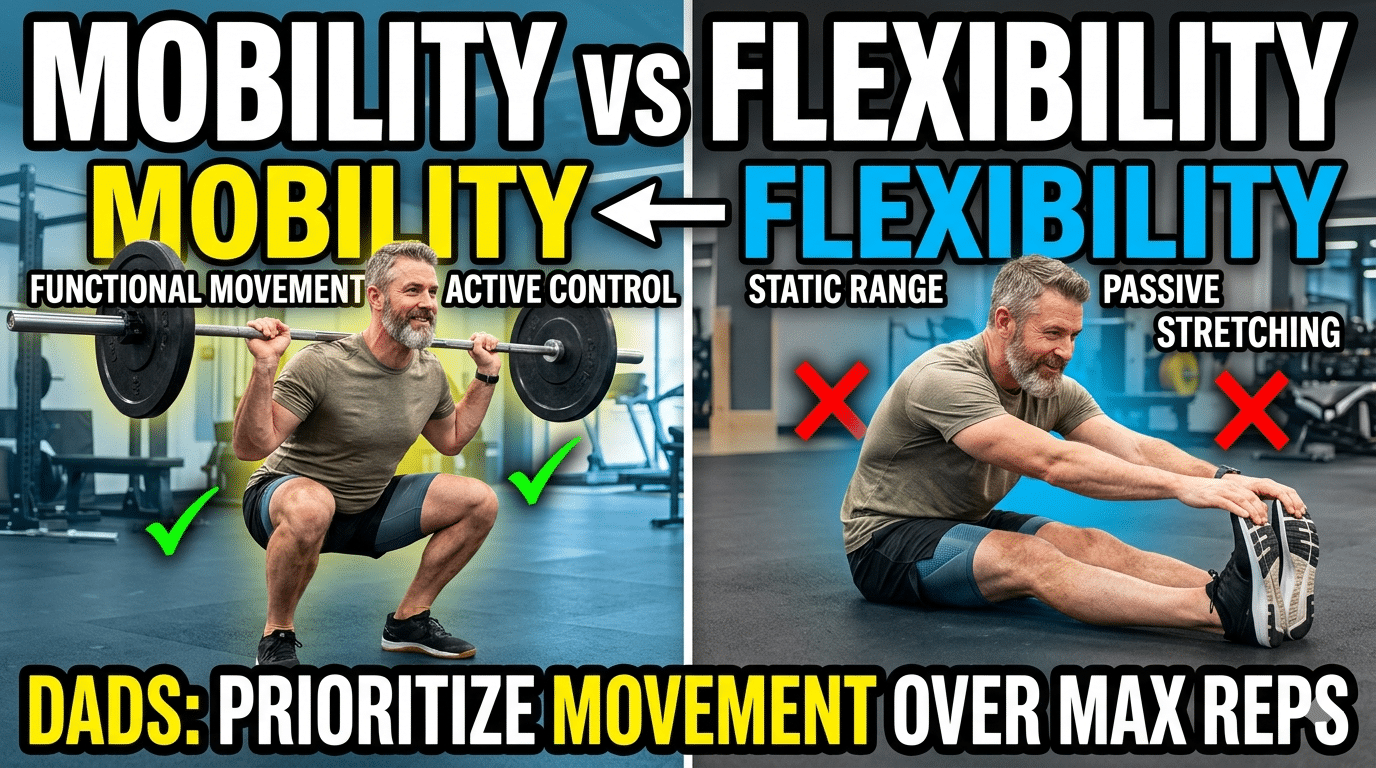
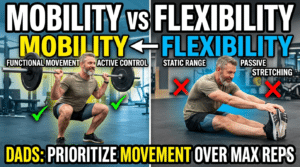
Flexibility is the passive range of motion around a joint. Think of a rubber band. If you can pull your heel to your glute while standing, you have flexible quads. It’s about muscle length. Mobility, however, is the active control of that range of motion. It is the intersection of flexibility and strength. It’s not just having a long rubber band; it’s being able to control how and when that band stretches and snaps back.
A flexible man can be moved into a position. A mobile man can move himself into a position. For dads, mobility is the insurance policy against the "snap, crackle, and pop" that comes with age. Flexibility without mobility is often a recipe for injury, as it creates a range of motion that the nervous system cannot actually control.
Why the "Max Reps" Obsession Is Failing You
When we were 20, our connective tissues were like sponges—pliant, hydrated, and forgiving. We could walk into a gym, skip the warm-up, and hit a personal best. At 40, those same tissues are more like leather. If you try to force a "max rep" on a leather-like joint that lacks mobility, something is going to tear.
Chasing max reps often leads to compensated movement. If your shoulders lack the mobility to press a weight overhead properly, your lower back will arch to "cheat" the weight up. Over time, these compensations lead to chronic pain. By prioritizing mobility over max reps, you are reinforcing proper movement patterns that keep you in the gym and out of the physical therapist's office.
| Feature | Flexibility | Mobility |
|---|---|---|
| Definition | Passive range of motion (muscle length). | Active range of motion (control + strength). |
| The Goal | Increasing the stretch of a muscle. | Improving joint function and nervous system control. |
| Example | Touching your toes while sitting. | A deep, controlled bodyweight squat. |
| Risk Factor | Hypermobility without strength = Joint instability. | Low mobility = Restricted movement and injury. |

The Science of Stiffness: What Happens at 40?
As we age, our bodies undergo a process called collagen cross-linking. Think of your fascia—the webbing that holds your muscles together—becoming sticky. If you spend 8 hours a day in a desk chair, your fascia begins to "set" in that seated position. Your hip flexors shorten, your glutes turn off, and your mid-back (thoracic spine) rounds forward.
This isn't just "getting old"; it's a lack of varied movement. When we stop moving through our full range of motion, the brain essentially "deletes" access to those ranges to save energy. This is why you feel stiff in the morning—your nervous system has literally tightened the brakes on your joints to protect you from movements it no longer trusts you to handle.
The "Dad Mobility" Reset: How to Prioritize Movement
You don't need to spend two hours on a yoga mat to see results. For the busy dad, mobility work should be integrated into your existing routine. Here is how to pivot your training focus:
1. Swap "Static Stretching" for "Controlled Articular Rotations" (CARs)
Don't just pull on your hamstrings for 30 seconds. Instead, move your joints through their full range of motion under tension. Shoulder circles and hip "fire hydrants" done with slow, intentional control tell your brain that you still "own" that space. This is the foundation of functional mobility.
2. Focus on "The Big Three" Mobility Hubs
For most men, three areas cause 90% of the problems:
- The Hips: Tight hips lead to lower back pain. Move them daily.
- The Thoracic Spine: A stiff mid-back kills shoulder health and posture.
- The Ankles: If your ankles don't move, your knees will take the brunt of the force during squats or running.
3. Strength Through Range
Instead of seeing "strength" and "mobility" as separate, combine them. A deep goblet squat is a better mobility tool than a leg stretch. A Bulgarian split squat builds strength while simultaneously stretching the rear hip flexor. This is "strength through range," and it is the gold standard for the 40+ man.
If you can't get to the gym, do 10 minutes of "floor time" while watching TV with the kids. Sit in a deep squat, do some 90/90 hip switches, and some cat-cow stretches. Consistent, low-intensity movement beats a once-a-week "intense" stretching session every time.
The Long-Term Goal: Functional Longevity
We train today so we can play tomorrow. If your "max reps" routine leaves you so sore you can't play catch with your son or take the dog for a hike, is it really serving you? True strength is the ability to show up for your life without physical restrictions.
By shifting your focus to mobility, you aren't "giving up" on strength. In fact, you'll find that as your joints move better, your strength actually increases because you're no longer fighting your own stiffness. You’ll be able to hit those reps with better form, deeper range, and significantly less recovery time.
Conclusion: Move Better to Live Better
The transition from 30 to 40 is a crossroads. You can continue to train like a 20-year-old until the injuries force you to stop, or you can evolve. Prioritizing mobility over max reps isn't a sign of slowing down—it's a sign of training smarter. At DadBod40, we don't want you to just be "strong for your age." We want you to be a master of movement, capable of handling whatever life throws at you.

J.V. CHARLES – DadBod40
J.V. Charles is the founder and senior editor of DadBod40. A performance coach specializing in functional movement for men over 40, J.V. advocates for a "longevity-first" approach to fitness. He believes that the ultimate measure of a man's health is his ability to remain active, mobile, and injury-free for the people who depend on him most.