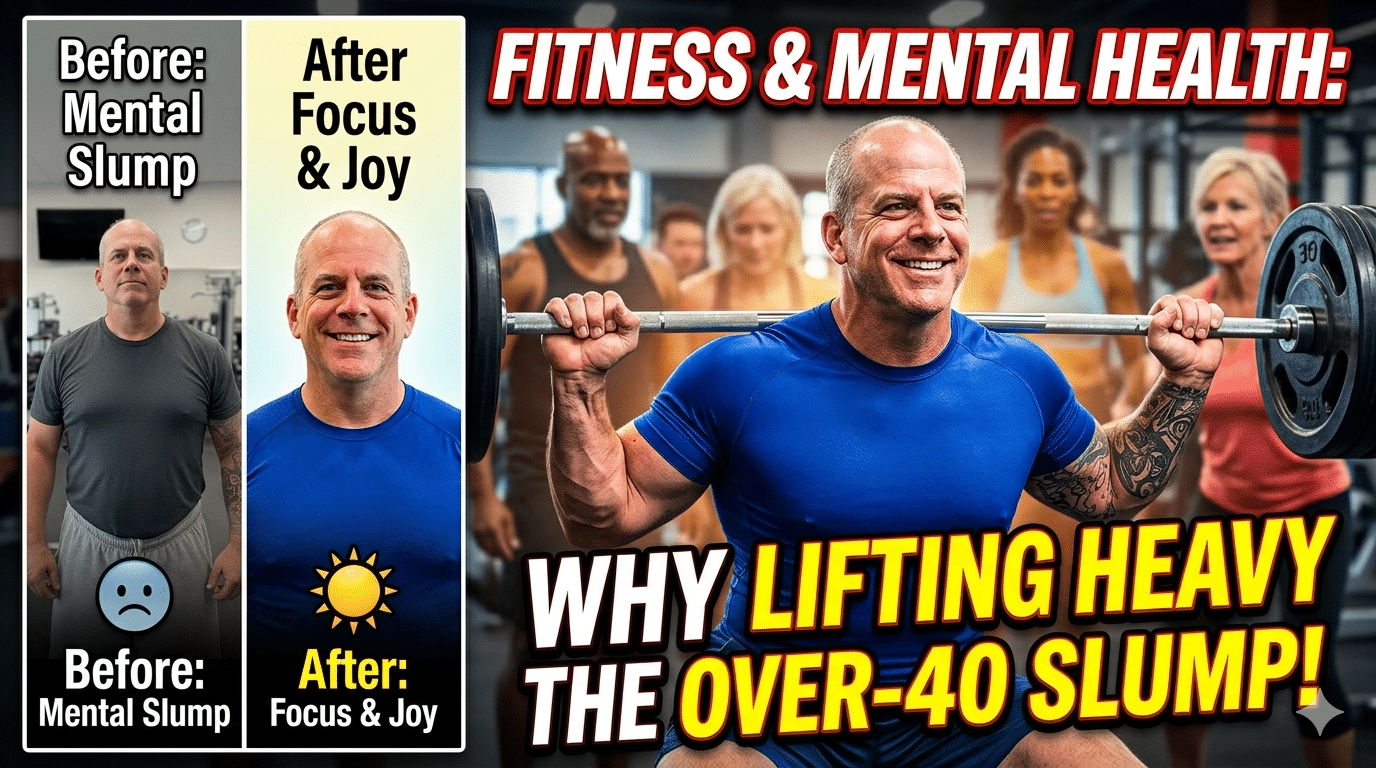

Fitness and Mental Health: Why Lifting Heavy Cures the Over-40 Slump
It hits somewhere between your late 30s and mid-40s. It isn’t a sudden, catastrophic crisis—no dramatic sports car purchases or sudden impulses to drop everything and move to an island. Instead, it’s a slow, gray fog that creeps into the corners of your mind. You wake up with a mild, lingering malaise. Your focus feels fractured, your patience with your family is thin, and the ambitions that used to drive your career feel more like heavy obligations.
Clinically, it gets labeled as mild depression, burnout, or generalized anxiety. In the real world, we just call it the "Over-40 Slump." It’s that persistent feeling that you are running on low battery, merely executing tasks rather than living life with drive. Traditional mental health advice tells you to sit on a couch and talk about your feelings, practice mindfulness apps, or cut back on commitments. And while those therapies have their place, they often miss a profound biological truth.
For a man over 40, your mental health is inextricably tied to your physical biology. When your muscles soften and your strength declines, your psychological resilience goes right down with it. If you want to blast through the midlife mental fog, you don't necessarily need a quieter mind—you need a heavier barbell. Moving serious weight under tension is one of the most effective, unheralded mental health interventions available. Here is why lifting heavy is the ultimate cure for the master's athlete's mind.

1. The Neurochemical Symphony of Iron
When you read about exercise and mental health, writers usually preach about the classic "runner's high"—that gentle wash of endorphins you get after a steady jog. Cardiorespiratory work is great for basic stress management, but a master’s body needs a much sharper chemical intervention to snap out of a deep mental rut.
When you execute a heavy set of compound movements—like squats, deadlifts, or overhead presses—your body perceives it as an acute survival event. The high mechanical load triggers an immediate, systemic response. Your brain floods your neural pathways with a massive dose of dopamine (the reward and motivation molecule), norepinephrine (which sharpens focus), and serotonin (which stabilizes mood).
Furthermore, lifting heavy stimulates the release of Brain-Derived Neurotrophic Factor, or BDNF. Think of BDNF as a premium fertilizer for your brain cells. It encourages neuroplasticity—the brain’s unique ability to grow new pathways and reorganize itself. Chronic stress and anxiety literally shrink the hippocampus, the region of your brain responsible for emotional regulation. Heavy strength training helps kickstart BDNF production, physically rebuilding the neural scaffolding needed to process stress effectively.
2. Involuntary Mindfulness: The Barbell as an Anchor
Most men over 40 struggle deeply with traditional mindfulness or meditation. Sitting quietly in a dark room trying to "empty your mind" usually just gives your brain a blank canvas to scroll through everything you're stressed about: mortgages, structural reorganizations at work, kids' tuition bills, and home repairs.
Heavy lifting solves this by introducing what psychologists call involuntary mindfulness. When you step underneath a heavy barbell for a squat, your brain is physically incapable of worrying about an email from your boss. The imminent physical load demands absolute, unyielding presence. If your mind wanders for even a split second, the lift fails.
For the one hour you spend in the gym, you are granted complete sanctuary from decision fatigue. You have exactly one, singular objective: control the descent, find your positioning, and drive the weight back up. This radical presence acts as a cognitive circuit breaker. When you step away from the iron, you’ll find that the problems that felt utterly overwhelming an hour ago have been scaled down to a manageable size.
3. Reversing the Hormonal Malaise
We cannot talk about an over-40 man's mental health without looking at his endocrine system. As established in our comprehensive guide on how to how to build muscle effectively after 40, circulating testosterone and growth hormone levels decline continuously with age, while baseline cortisol (the primary stress hormone) tends to creep up due to life's compounding pressures.
Low testosterone isn't just about losing muscle mass or physical stamina; it is a primary driver of midlife psychological symptoms. Men with low testosterone levels frequently report heightened anxiety, uncharacteristic irritability, chronic low energy, and a distinct loss of competitive drive. It is a biological recipe for a depressive slump.
While light cardio does very little to move the needle on your hormone profile, moving heavy loads forces your body to adapt. Recruiting large, high-threshold motor units during multi-joint lifts signals your endocrine system that it needs to keep producing androgenic hormones to repair the structural stress. By optimizing your natural hormonal baseline, you treat the physiological root cause of the mental slump, rather than just masking the psychological symptoms.
The Anti-Slump Training Framework
If you are lifting specifically to pull yourself out of a mental rut, alter your programming rules to keep your central nervous system from burning out:
- Keep it brief: Cap your high-intensity lifting sessions at 45 to 60 minutes. Extended training sessions cause a steep rise in cortisol, which can worsen anxiety and fatigue.
- Focus on big movements: Prioritize compound movements that tax large muscle groups over isolation exercises. A heavy row or press provides a far greater neurochemical response than bicep curls.
- Track your progress: Write down your weights and reps. Seeing definitive, measurable proof of your own growth on paper provides an invaluable psychological win that offsets the ambiguity of daily life.
4. Reclaiming Agency Over Your Body
A massive component of the over-40 slump is a creeping sense of powerlessness. You watch your body change in ways you didn't authorize. Joints begin to ache, recovery slows down, and your midsection holds onto fat more easily. It feels like your physical self is on a slow, downward trajectory that you can't control.
Lifting heavy weight shatters this illusion of helplessness. When you walk into a gym, select a weight that used to pinning you down, and press it through space, you prove to yourself that you possess direct agency over your environment. You are no longer just a passive observer of your body's aging process; you are actively directing its structural adaptation.
This sense of mastery quickly bleeds into every other area of your life. The resilience required to grind through a tough set of lifts reinforces your mental toughness outside the gym walls. If you can handle the intense discomfort of a heavy set of squats, you can confidently navigate a difficult conversation with a client, handle a family crisis with composure, and lead your household with steady confidence.
Ego Lifting vs. Heavy Lifting
Do not confuse "lifting heavy" with reckless, uncontrolled maximum-effort attempts. At 40+, "heavy" means heavy *for you* while maintaining absolute mechanical integrity. True heavy training means operating in the 6-to-10 rep range with a weight that leaves exactly 1 or 2 clean reps in the tank (RIR). Flirting with horrific form to impress strangers will only lead to severe joint injury, which will tank your mental health faster than any slump ever could.
The Barbell Strategy for Life
If you are currently trapped in the midlife slump, stop waiting for your mood to improve before you pick up the weights. Your mind will not think its way out of a biological deficit. You must move your way out of it.
The iron doesn't care about your job title, your age, your stress, or your doubts. It offers an completely honest, objective relationship: give it focus and effort, and it will return physical strength and mental clarity. Stop treating your workouts as a superficial chore to change how you look in the mirror. View them as a critical, life-saving strategy to protect your mind, fortify your spirit, and master the second half of your life. Pack your bag, step up to the platform, and change your chemistry.

Joshua Van
Joshua Van is the founder and senior editor of DadBod40. He’s helped thousands of men navigate the often-intimidating world of fitness after 40. Joshua believes that fitness is not a display of ego, but a foundational requirement for living a high-performance life as a father, professional, and man.